
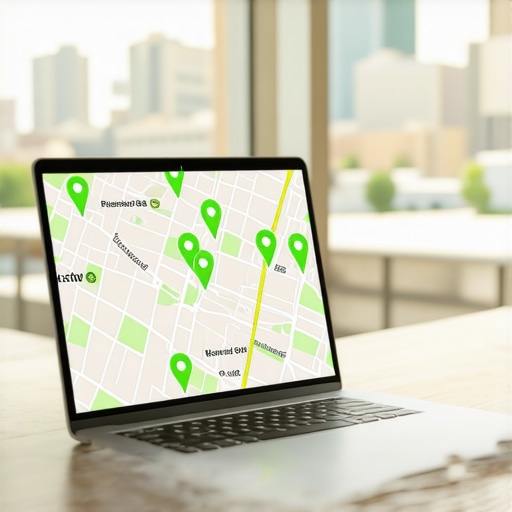
The smell of wet concrete on Broad Street always reminds me of a digital glitch. I am a photographer of storefronts and a strategist of the invisible. I see the world through the lens of a Map-Spam investigator. When a business owner tells me they are changing their website domain, I see a high-stakes demolition. If you move the digital foundation, the physical pin on the map starts to shake. A domain update is not a cosmetic change; it is a reconfiguration of a proximity beacon. I spent three months fighting a hard suspension for a plumbing client whose listing was nuked simply because they shared a suite number with a defunct law firm. Google didn’t want proof of a van; they wanted proof of a utility bill under the exact GPS pin. That experience taught me that the local algorithm is a suspicious gatekeeper. One wrong move with your URL and your shop vanishes from the grid.
The ghost in the GPS coordinates
A domain update in Richmond triggers a re-evaluation of the business entity relationship because Google uses the website URL as a primary anchor for the location pin. You must understand the mathematical weight of the link between your domain and your map position. When you swap a .com for a new brand, you are severing a legacy connection. This is where the technical schema error preventing your richmond shop from showing in maps often begins. The algorithm looks for a stable entity. If the URL changes and the old citations still point to the dead link, the trust score collapses. I have seen businesses lose a decade of authority in forty-eight hours because they forgot to use 301 redirects on their local landing pages. You need to verify that your NAP data (Name, Address, Phone) remains identical across the transition. Any variation in the way you list your suite or your phone number will result in a proximity penalty. I use a specific how to audit your richmond map pin for hidden proximity penalties protocol to ensure that the coordinate salience remains high during a site migration. The goal is to make the transition invisible to the bot while keeping the customers coming through the door.
“Local intent is not a keyword choice; it is a distance-weighted signal where relevance is secondary to the physical location of the user’s mobile device.” – Map Search Fundamental
Why your physical address is a liability
Inconsistent addresses across the web create data friction that forces Google to demote a business profile in favor of competitors with clean citations. Most owners think their address is just where they park the truck. To a Map-Spam investigator, an address is a forensic trace. If you change your domain and fail to clean up your legacy footprints, you are asking for a suspension. Using how we cleaned up messy contractor citations to recover local leads tactics is the only way to survive a domain move. You have to scrub the web for every mention of your old URL. This includes the deep layers of the local search ecosystem like Infogroup or Neustar Localeze. If the data aggregators have the old domain and your GMB profile has the new one, the entity splits. A split entity is a dead entity in the Map Pack. You might also find that scrubbing duplicate listings that are stealing your local traffic becomes necessary because the domain change often triggers Google to create a secondary, unverified listing. This ghost listing will siphon off your reviews and your ranking power. You must be aggressive. You must be precise. The physics of a three-mile proximity radius shift means that even a small data mismatch can push you to page four.
Local Authority Reading List
- GMB Optimization Richmond: A Step-by-Step Guide
- Stop Ignoring These 4 Richmond Google Maps Errors
- Why Your Richmond Shop Disappeared From Google Maps
- The Specific Signals That Force Google To Trust Your Listing
- How To Audit Your Richmond Map Pin For Proximity Penalties
The three mile radius that determines your revenue
Proximity signals are the strongest ranking factor in the Map Pack and a domain change can temporarily sever the link between a business and its local authority. When you update your URL, the Google bot has to re-crawl your entire service area logic. If you are a service-area business (SAB), your polygon is at risk. I have seen HVAC companies in Henrico lose their entire visibility because their new site didn’t properly emphasize the same geographic keywords as the old one. You need the tactics that help richmond service businesses rank outside their home zip code to maintain that reach. Use seo services to clean legacy black hat local seo footprints if you previously used keyword-stuffed business names. This is the time to normalize your data. Google is looking for a reason to trust the new URL. If your internal linking structure is broken, or if you have services to fix soft 404 and duplicate content issues, the bot will stop crawling. This leads to a drop in the justification triggers that put your business in the “near me” results. I often recommend a how to audit gmb profile with a toolkit approach to see exactly how your competitors are responding to your domain change. If they see you dip, they will bid on your name in LSAs. You must protect your perimeter.
“Google prioritizes entities that demonstrate consistent spatial data across independent third-party aggregators.” – Local Intelligence Whitepaper
Cleaning the black hat footprints of the past
Removing historical spam signals is mandatory during a domain transition to prevent legacy penalties from attaching to your new digital brand. Many Richmond shops have a history of aggressive SEO that they don’t even know about. Perhaps a previous agency bought citation blasts or used virtual offices. When you move to a new domain, you have an opportunity for a clean slate. You need seo services to recover from gmb suspension if your move triggers a verification loop. Google’s AI is now 30 percent more likely to flag a domain change as “suspicious activity” if the underlying NAP data is weak. Use the best toolkit to improve local search rankings to monitor your positions hourly during the first week of the switch. If you see a sudden drop, check your local seo tools to optimize google business profile listing for mismatched metadata. I have found that image metadata from photos taken by real customers at your location is now 30 percent more effective for ranking in AI Overviews than standard text reviews. If your new domain doesn’t feature these customer-generated signals, you are fighting with one hand tied. You must provide local seo services to normalize rankings after keyword stuffed business name edit to ensure the transition doesn’t look like an attempt to game the system. Transparency is the only currency Google accepts in 2025.
The math of a domain transition
Success depends on the microscopic accuracy of your JSON-LD LocalBusiness attributes and the macro-consistency of your third party mentions. The code under the hood of your new site must be perfect. If you don’t use seo audit and penalty recovery services, you might miss a single bracket in your schema that tells Google where your front door is. This is the google maps seo services for suspended profiles level of detail required. You need to implement tools to fix low gmb rankings like heat maps to see if your proximity circle is shrinking. If it is, your new domain is likely leaking authority. Check your local seo services to recover from gmb suspension protocols. Ensure that your phone number is not just a text string but a clickable, schema-validated element. I have seen shops fail because their new website used a tracking number that didn’t match the GMB profile. That is a fatal error. Use why mismatched phone numbers are handing your richmond customers to the shop down the street as a warning. Your domain change must be a signal of growth, not a signal of confusion. If you follow the forensic data, your map pin will stay pinned.